The Complete Guide to Buying a Condo in Bangkok as a Foreigner (2026)
You found a condo you like in Bangkok. The view is great, the agent is friendly, and the price feels right. So you wire the money, sign some papers, and… congratulations, you now own a unit with cracked tiles, a leaking balcony, and an AC system held together by hope.
This happens more often than you’d think.
Buying a condo in Bangkok as a foreigner looks simple on paper. Thailand is one of the few countries in Southeast Asia where foreigners can own property freehold. But the process has enough quirks, paperwork traps, and hidden costs that going in blind will cost you.
This guide covers the full process from start to finish, including the one step that almost every other buying guide leaves out.
Can foreigners actually own a condo in Thailand?
Yes. Foreigners can own condo units freehold under the Condominium Act B.E. 2522 (1979). No nominee structures, no workarounds needed. Your name goes on the title deed at the Land Department.
But there are rules.
The 49% foreign quota
Every registered condominium in Thailand reserves at least 51% of the total saleable area for Thai nationals. Foreigners can own up to 49% of the building’s floor space.
This is measured by area, not by number of units. So if a building has 10,000 square meters of sellable space, foreigners can collectively own up to 4,900 square meters.
Why this matters to you:
- Popular buildings in prime areas (Sukhumvit, Silom, Sathorn, Riverside) often have their foreign quota full or nearly full. If the quota is maxed out, you simply cannot buy freehold in that building as a foreigner.
- Always verify the current foreign quota with the building’s juristic person (management office) before putting down any money. Ask for the quota in writing.
- Some agents will tell you “there’s still quota” without actually checking. Verify independently.
Freehold vs. leasehold
| Freehold | Leasehold | |
|---|---|---|
| Ownership | You own the unit outright | You lease for up to 30 years |
| Title deed | Your name on the chanote | Lease registered on the title |
| Foreign quota | Counts against the 49% | Does not count against quota |
| Resale | Sell to anyone (within quota) | Assign remaining lease term |
| Inheritance | Passes to heirs | Depends on lease terms |
| Price | Full market price | Typically 10-30% less |
Freehold is what most foreign buyers want. Leasehold is sometimes the only option if the foreign quota is full, or in buildings that only offer leasehold to foreigners (some older developments do this).
Leasehold contracts often mention “renewable for two additional 30-year terms” (totaling 90 years). Those renewal clauses beyond the first 30 years are not enforceable under Thai law. A court may honor them, or it may not. There’s no guarantee.
How money gets into Thailand: the FET form
This trips up more foreign buyers than anything else.
To register freehold ownership, the Land Department requires proof that the purchase funds came from outside Thailand. That proof is a Foreign Exchange Transaction form (FET), issued by a Thai bank when you transfer foreign currency into the country.
The rules:
- The transfer must be in foreign currency (USD, EUR, GBP, JPY, etc.), not Thai baht
- The amount must be at least USD 50,000 equivalent (or the full purchase price, whichever applies)
- The transfer must be made to your Thai bank account in your name
- The receiving bank converts it to baht and issues the FET form
- The FET must state the purpose as “purchase of condominium” or similar
Common mistakes:
- Transferring baht instead of foreign currency (no FET issued)
- Sending money in multiple small transfers below the threshold
- Having the transfer come from someone else’s overseas account
- Losing the FET form (get multiple certified copies from the bank immediately)
- Not specifying the purpose of the transfer
Without a valid FET, the Land Department will not register the transfer in your name as freehold. No exceptions.
If you already have money sitting in a Thai bank account from salary or business income, that money typically can’t be used for freehold condo purchase unless you can show it originated from abroad with proper FET documentation.
The buying process: step by step
Step 1: Set your budget (including all fees)
The listed price is not your total cost. Budget for these on top:
| Fee | Amount | Who pays |
|---|---|---|
| Transfer fee | 2% of appraised value | Usually split 50/50 (negotiable) |
| Specific Business Tax | 3.3% (if seller owned < 5 years) | Usually seller |
| Stamp duty | 0.5% (if SBT doesn’t apply) | Usually seller |
| Withholding tax | 1-3% (depends on seller type) | Seller |
| Sinking fund | Varies (one-time, for new builds) | Buyer |
| Common area fees | First year often prepaid | Buyer |
| Legal fees | THB 20,000-80,000 | Buyer |
| Inspection | From US$499 / THB 15,900 | Buyer |
A note on the transfer fee stimulus: The Thai government has periodically offered reduced transfer fees (from 2% to 1%) and mortgage registration fees to stimulate the property market. The latest round, announced in late 2024, applies primarily to Thai nationals purchasing properties under certain price thresholds. Foreign buyers generally don’t qualify for these reductions. Confirm current rates with your lawyer before budgeting.
Step 2: Find the right property
You have two main paths: resale units and new builds (off-plan or completed).
Resale (secondhand) units:
- What you see is what you get. You can inspect the actual unit.
- Negotiate directly with the owner or their agent.
- Buildings are established, so you can check actual management quality, common area condition, and talk to other residents.
New builds (off-plan):
- Lower entry price, but you’re buying a promise.
- Developer reputation matters a lot. Research their track record.
- Construction delays are common. 6-12 month delays happen regularly.
- The finished product may differ from the showroom.
Off-plan buyer protection (January 2025): The OCPB (Office of the Consumer Protection Board) introduced updated regulations for off-plan condo sales effective January 2025. Developers now have to use standardized sales contracts, provide clearer project completion timelines, and meet specific escrow requirements for buyer deposits. This gives off-plan buyers more protection than before, though enforcement varies. Ask to see the OCPB-compliant contract before signing anything.
Step 3: Check the foreign quota
Before you fall in love with a unit, verify the building’s foreign ownership quota with the juristic person. Request the current ratio in writing. If the building is at or near 49%, you need to know before you put down a reservation deposit.
Step 4: Make a reservation
For resale units, you’ll typically pay a reservation deposit (THB 50,000-200,000) to take the unit off the market while due diligence proceeds. This may or may not be refundable depending on the agreement. Read the terms carefully.
For new builds, reservation deposits are similar but the purchase agreement structure differs. You’ll sign a Sale and Purchase Agreement (SPA) and make installment payments during construction.
Step 5: Hire a lawyer
Get an independent Thai property lawyer. Not the developer’s lawyer. Not the agent’s lawyer. Your own.
Your lawyer should:
- Review the sales contract (Thai version, not just the English translation)
- Conduct a title search at the Land Department
- Verify the foreign quota status
- Check for any encumbrances, liens, or legal disputes on the unit
- Verify the seller actually owns the unit and has the right to sell
- Handle the FET documentation requirements
- Represent you at the transfer
Legal fees for condo purchases typically run THB 20,000-80,000 depending on complexity. Compared to the purchase price, this is nothing.
Step 6: Due diligence
Your lawyer handles the legal side. But there’s more to check:
Building health:
- Review the juristic person’s financial statements. Is the sinking fund healthy or depleted?
- Check for any pending special assessments or major repairs planned.
- Look at common area maintenance. Are the hallways, lobby, pool, and gym well-maintained? Neglected common areas signal deeper management problems.
Unit history:
- How long has the unit been on the market? A unit sitting unsold for 12+ months might have issues.
- Why is the seller selling? Renovation needs, building disputes, or neighborhood changes are worth knowing about.
Building and neighborhood:
- Visit at different times of day. The quiet building at 2pm might have a nightclub-level bar next door at midnight.
- Check construction nearby. Bangkok has constant development. Your panoramic view might become a view of a construction crane for the next three years.
Step 7: Arrange the transfer funds
Wire the purchase funds from your overseas bank account to your Thai bank account in foreign currency. Make sure the bank issues the FET form. Double-check that the purpose stated on the FET matches “condominium purchase” or equivalent language.
Do this well before the transfer date. International transfers can take 3-7 business days, and banks occasionally need extra documentation for large transfers (anti-money laundering checks are standard).
Step 8: Get a professional inspection before transfer
This is the step every other buying guide skips. It’s also the step that can save you the most money.
Why inspect before you transfer ownership?
Once you’ve transferred the condo into your name and paid the full price, your negotiating power drops to almost zero. Any defects you discover after transfer are yours to fix, at your expense.
Before transfer, you have leverage. You can negotiate repairs, price reductions, or walk away entirely.
What does a professional inspection actually find?
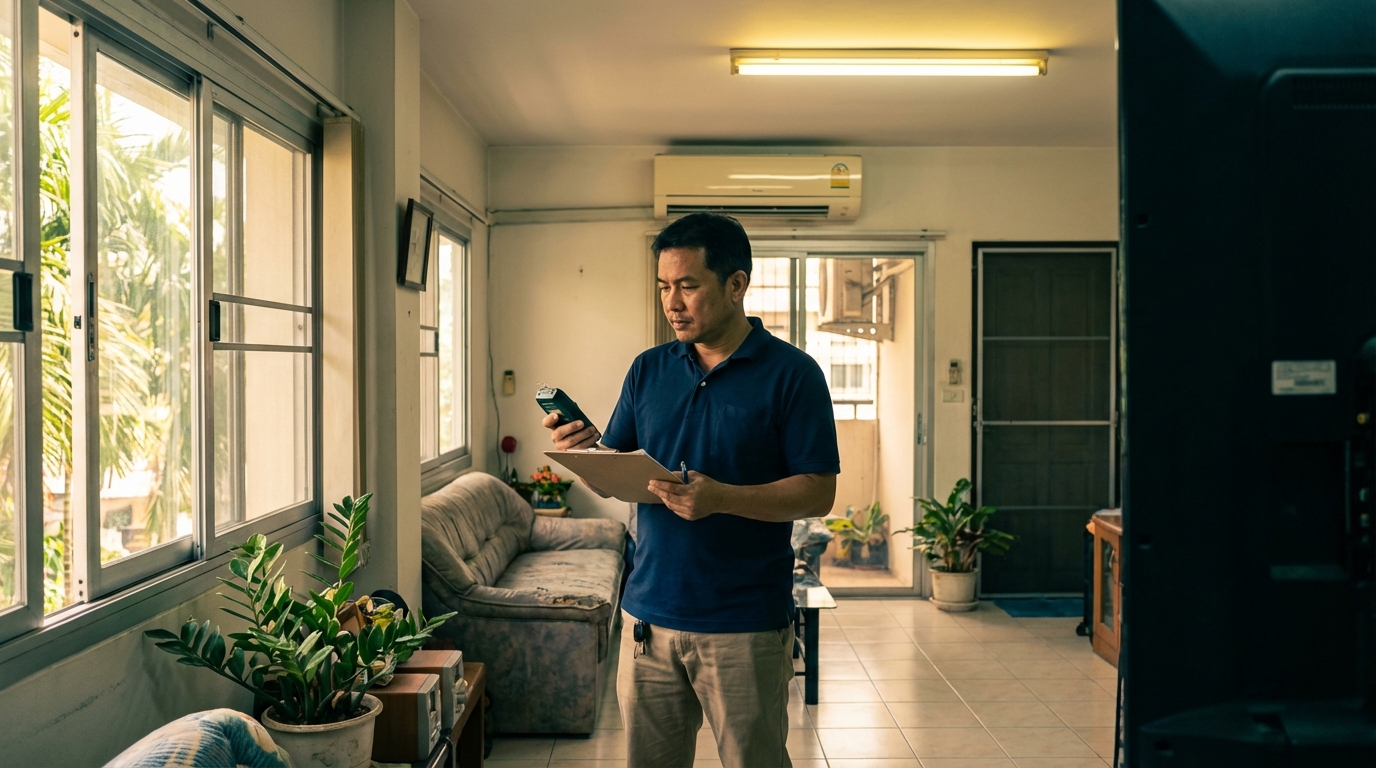
We inspect condos in Bangkok every week. Here’s what shows up regularly in units that looked fine during viewings:
- Water leaks from balconies and windows. Bangkok’s rainy season exposes sealing failures. A balcony that looks dry in January might have water pooling against the sliding door frame by June. We check drainage slopes, sealant condition, and waterproofing integrity.
- Cracked tiles and uneven flooring. Hollow-sounding tiles (detected by tapping) mean poor adhesive coverage. They’ll crack under furniture weight over time.
- Electrical issues. Incorrectly wired outlets, missing ground connections, overloaded circuits. A viewing won’t reveal these. A multimeter will.
- Plumbing problems. Slow drainage, incorrect pipe falls, joints that seep under pressure. We run every tap and flush every toilet.
- AC systems running on borrowed time. Units that haven’t been occupied in months often have AC units with blocked drains, dirty coils, and refrigerant issues that only show up under sustained use.
- Structural cracks. Not every crack is cosmetic. Cracks that follow specific patterns (diagonal from window corners, horizontal along wall joints) can indicate structural movement.
For new builds, the defect list is often longer. Construction quality in Bangkok varies wildly between developers and even between floors of the same building. We regularly find 20-50 defects in brand-new units during pre-transfer inspections.
The 5-year structural warranty most buyers don’t know about:
Under Section 600 of Thailand’s Civil and Commercial Code, contractors are liable for structural defects for 5 years from completion. Many buyers (and some agents) think the warranty period is only 1 year. That’s wrong. The 1-year figure applies to the developer’s cosmetic defect warranty, which is a separate, contractual matter. The statutory 5-year period covers structural work. It’s the law, not something the developer can opt out of.
An inspection report documenting structural issues before or shortly after transfer creates a paper trail you can use to hold the developer accountable within this period.
What an inspection costs vs. what it saves:
A professional condo inspection runs US$499 / THB 15,900 for units up to 120 square meters. For houses and penthouses over 120 sqm, pricing is quoted individually depending on property size and scope.
On a THB 5 million condo, that’s about 0.3% of the purchase price. We routinely find issues that would cost THB 50,000-200,000 to fix. The math is simple.
Step 9: Transfer at the Land Department
On transfer day, you (or your lawyer with power of attorney), the seller, and your respective lawyers meet at the local Land Department office. The process involves:
- Submitting the FET form and bank documentation
- Paying the transfer fee and applicable taxes
- The Land Department officer checking the foreign quota
- Signing the transfer documents
- Receiving the updated title deed with your name
The whole thing takes 2-4 hours if everything is in order. If documentation is missing or incomplete, you may need to come back another day.
Common pitfalls (and how to avoid them)
Nominee structures
Some foreigners try to bypass the 49% quota by setting up a Thai company to hold the remaining 51% of shares, with Thai “nominees” as majority shareholders. This has always been legally questionable, and Thai authorities have been cracking down on these arrangements with increasing seriousness.
The Land Department and Department of Business Development have been actively investigating nominee company structures, particularly for property holding companies with no genuine business operations. Penalties can include forced dissolution of the company and loss of the property.
If someone suggests a nominee structure, understand the risks. This is a conversation for your lawyer, not your agent.
The March 2025 earthquake and buyer confidence
The earthquake that hit in March 2025 shook more than buildings. It shook buyer confidence. Bangkok had never experienced anything like it in living memory, and suddenly every buyer was asking about structural integrity.
Some things worth knowing:
- Most modern Bangkok condos (post-2000) are designed to meet seismic codes, though these codes were historically minimal given Thailand’s perceived low seismic risk.
- Older buildings (pre-1990s) may not have been designed with earthquake resistance in mind.
- A professional inspection can identify visible signs of structural stress, though a full structural engineering assessment is a separate, specialized service.
- If you’re buying in a building that was standing during the March 2025 event, ask the juristic person whether a structural assessment was done afterward and what it found.
Buying for rental yield
Many foreign buyers plan to rent out their condo for income. Be realistic about yields. Net rental yields in Bangkok typically run 3-5% for well-located condos, and that’s before management fees, vacancy periods, maintenance, and income tax.
Thailand taxes rental income for foreigners at progressive rates up to 35%. Some buyers structure this through a company, but that has its own costs and complications.
Underestimating ongoing costs
Your monthly common area fee (CAM fee) covers building maintenance, security, pool, gym, and shared utilities. These fees go up over time, often 5-10% every few years. Budget for that.
Sinking funds can also be topped up via special assessments if the building needs major repairs (new elevators, facade work, pipe replacement). If the building’s sinking fund is underfunded, expect a call for extra contributions.
Skipping the inspection
We’re biased, obviously. But the number of buyers who transfer multi-million-baht properties based on a 20-minute viewing and an agent’s assurance that “everything is fine” is alarming.
The agent has no liability for defects after transfer. The seller has limited obligations once the sale is completed. You’re the one living with whatever problems exist in those walls.
2025-2026 regulatory updates worth knowing
| Update | Date | Impact |
|---|---|---|
| OCPB off-plan buyer protection rules | Jan 2025 | Standardized contracts, escrow requirements for off-plan deposits |
| Nominee company crackdown | Ongoing 2024-2026 | Active investigation of Thai companies holding property for foreigners |
| Transfer fee stimulus | Late 2024 onwards | Reduced transfer fees primarily for Thai nationals; foreign buyers generally excluded |
| Earthquake building assessments | Post-March 2025 | Many buildings conducted voluntary structural reviews |
Quick reference: foreign condo buying checklist
- Verify foreign ownership quota with the juristic person (in writing)
- Hire an independent Thai property lawyer
- Confirm title deed type and check for encumbrances
- Wire funds in foreign currency and obtain FET form from Thai bank
- Review the sales contract (Thai version, with your lawyer)
- Check the building’s sinking fund and financial statements
- Visit the building at different times of day
- Get a professional inspection before transfer
- Budget for all fees beyond the purchase price (transfer fee, legal, sinking fund, CAM)
- Attend transfer at the Land Department (or send lawyer with power of attorney)
Get your condo inspected before you buy
You’re about to spend millions of baht on a property in a country where you probably don’t speak the language, can’t read the building codes, and have limited legal recourse after transfer.
A professional inspection gives you a clear picture of what you’re buying before the money changes hands. Every defect documented is either a negotiation point or a reason to walk away.
Book your pre-purchase condo inspection with Bangkok Inspect. One inspection. One price. Everything checked.
Bangkok Inspect provides property inspection services only. This article is general information and does not constitute legal or financial advice. For legal matters, consult a licensed Thai attorney. For financial matters, consult a qualified accountant.