Is Your Bangkok Condo Safe After the 2025 Earthquake?
On March 28, 2025, a 7.7-magnitude earthquake hit Myanmar. Bangkok is roughly 1,000 kilometers from the epicenter. That distance should have meant nothing happened here. Instead, a 33-story building under construction collapsed, killing 95 people. The BMA reported 169 buildings with cracking across inner Bangkok. Suddenly, everyone in the city was asking the same question: is my building safe?
A year later, that question matters more than ever if you’re buying a condo in Bangkok. The earthquake shook more than buildings. It shook confidence. And it revealed some uncomfortable truths about Bangkok construction that buyers need to understand before putting down money.
What actually happened to Bangkok’s buildings
The good news first. The vast majority of buildings in Bangkok came through the earthquake with zero damage. Out of 5,994 high-rise buildings in the city, most were completely fine. The one that collapsed was under construction, not a completed residential building. That distinction matters.
But 169 buildings did report cracking. The BMA sent letters to over 11,000 building owners requesting safety assessments. Some buildings got assessed quickly. Others didn’t respond at all. That gap between “assessed” and “not assessed” is exactly where risk lives for buyers.
The earthquake also confirmed something geologists have been saying for years: Bangkok sits on soft clay soil, and that soil amplifies seismic waves. A quake centered 1,000km away shouldn’t cause this much damage. The soft ground underneath the city acts like a bowl of jelly, wobbling longer and harder than solid rock would. Tall buildings on soft soil are particularly affected because the soil’s natural frequency can match the building’s sway period, making movement worse.
Not all cracks are the same
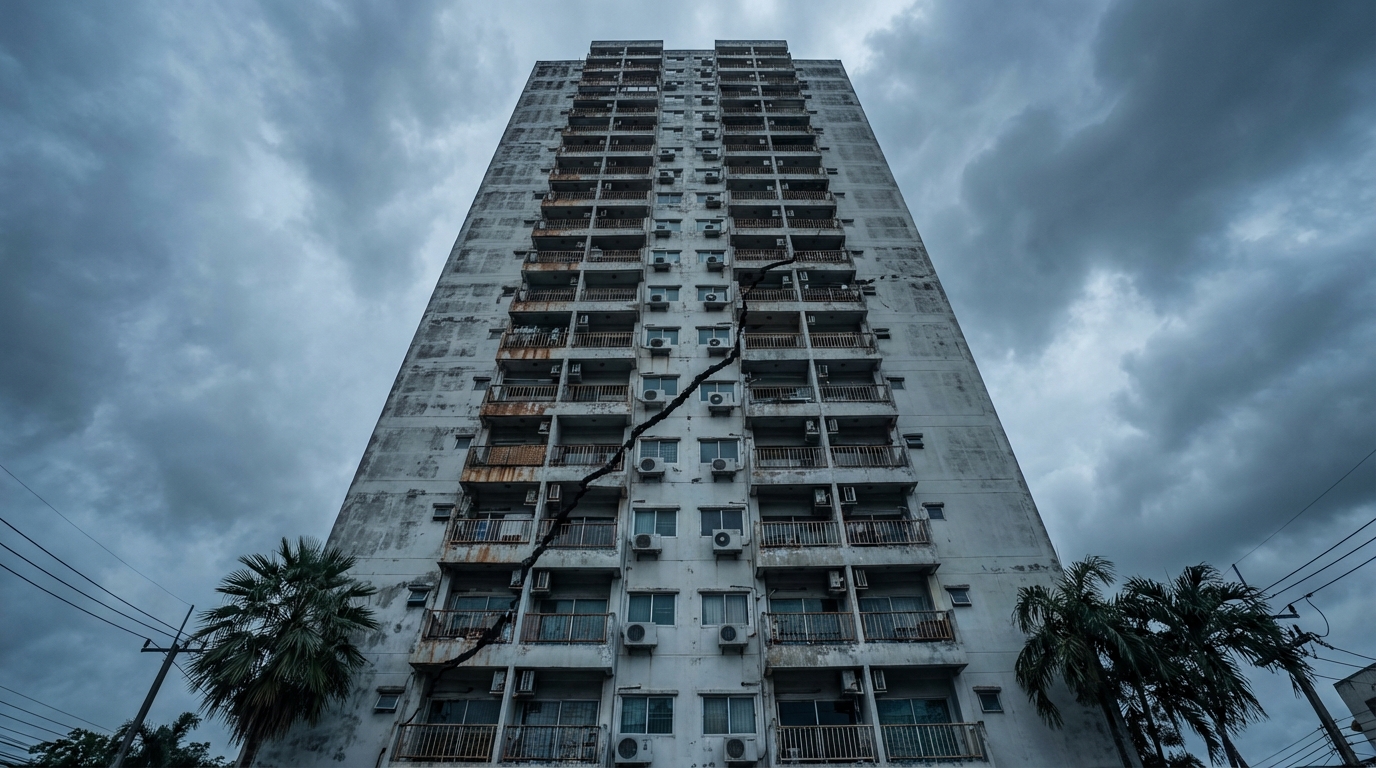
After the earthquake, plenty of condo owners panicked about cracks in their walls. That panic was understandable but often misplaced. Most cracks that appeared were cosmetic. Some were not.
Cosmetic cracks are hairline thin (under 1mm wide). They appear in plaster, paint, or surface finishes rather than in the concrete itself. They tend to follow straight horizontal or vertical lines, usually where different materials meet, like where a wall meets a ceiling. These cracks look alarming but they’re superficial. Plaster cracks during seismic movement because it’s rigid and brittle. The structure underneath can be perfectly sound.
Structural cracks are different. They’re wider, often 3mm or more. They run diagonally, especially in stairwells and around door frames. They appear in concrete or masonry, not just surface finishes. You might see them near load-bearing columns or where beams connect to walls. Sometimes the two sides of the crack are offset, meaning one side has shifted relative to the other. That’s a serious sign.
A few specific patterns to watch for:
- Diagonal staircase cracks that follow a stepped pattern through masonry blocks. These indicate shear stress on the wall.
- Cracks around column-beam joints. Seismic forces concentrate here. Cracking in these spots suggests the building absorbed more energy than its frame comfortably handles.
- Cracks wider at the top than at the bottom (or vice versa). This can indicate differential settlement, meaning part of the foundation has moved.
- New cracks that keep growing. If a crack was 1mm in April 2025 and it’s 3mm now, that’s active movement. The building hasn’t settled.
If you’re viewing a condo and you see cracks, pull out your phone. Take photos with something for scale (a coin works well). And ask questions.
What buyers should be asking
Before the earthquake, nobody asked about seismic safety when buying a Bangkok condo. Now you should. Here’s what to ask the building’s juristic office or the seller:
“Has this building had a post-earthquake structural assessment?” After the BMA’s request, many buildings hired engineers to do assessments. If the building had one done, ask to see the report. If they didn’t, ask why not.
“Were any cracks reported or repaired after March 2025?” Some buildings patched cracks quickly. That’s fine if they were cosmetic. But if structural repairs were done, you want to know what was found and who did the work.
“When was this building constructed?” This one matters. Thailand updated its building code for seismic resistance in 1997, again in 2007, and again in 2021. Buildings constructed before 1992 were built with essentially no seismic design considerations. That doesn’t automatically make them unsafe, but it means they were designed for a world where Bangkok earthquakes “didn’t happen.”
“What type of foundation does the building use?” Most modern Bangkok high-rises use deep piled foundations driven down through the soft clay to solid ground 20-25 meters below. Older or shorter buildings sometimes sit on shallower foundations, which are more susceptible to soil movement.
“Has the building had any water ingress issues since the earthquake?” Seismic movement can break waterproof seals around windows, joints, and the building envelope. Water intrusion after an earthquake sometimes points to structural movement that isn’t visible as cracking.
Pre-1992 buildings: extra caution
Thailand’s first real seismic building code provisions came in the mid-1990s after several smaller quakes in the north. Before that, Bangkok buildings were designed for gravity loads (the weight of the building and its contents) and wind loads, but not for lateral seismic forces.
Does that mean every pre-1992 building is dangerous? No. Many older buildings in Bangkok were overbuilt by today’s standards because engineering margins were generous. Some have been retrofitted. But as a buyer, you have no way to know that from a viewing.
If you’re looking at a unit in a building completed before the early 1990s, getting an independent assessment is worth the peace of mind. At minimum, you want someone who isn’t the seller to look at the building’s condition.
What a post-earthquake inspection looks for
When we inspect a condo in the post-earthquake market, we’re looking at things that weren’t on anyone’s checklist two years ago.
Crack patterns and documentation. We photograph and measure any visible cracks, noting their location, direction, and width. A crack map tells a story. Random hairline cracks in plaster tell a different story than diagonal cracks concentrated around structural columns.
Door and window alignment. This is a surprisingly good indicator of structural movement. If doors stick or don’t close properly when they used to, or if you can see uneven gaps around door frames, the frame may have shifted. We check multiple doors and windows throughout the unit and in common areas.
Floor leveling. We check floors for slope and unevenness. Some settlement is normal in any building, especially in Bangkok’s soft soil. But new or uneven settlement after an earthquake can point to foundation issues. We use a level to measure this rather than relying on feel.
Common area indicators. The unit itself might look perfect while the building tells a different story. We look at parking structure columns, stairwells, elevator shafts, and the building’s exterior. Structural problems tend to show up in these areas first because they’re less likely to be cosmetically repaired.
Water damage patterns. New water stains or moisture around windows, balcony doors, or on ceilings can mean seismic movement broke seals that were previously watertight. We check with moisture meters, not just our eyes.
Previous repair work. Fresh paint or new plaster in specific spots can indicate repairs. That’s not necessarily bad, but you want to know what was underneath. We look for signs of patching and ask about repair history.
Soft soil and what it means for your building
Bangkok’s geology is unusual for a major city. The entire metropolitan area sits on a deep layer of marine clay deposited when the area was underwater thousands of years ago. This clay is soft and water-saturated.
During an earthquake, this soft soil amplifies seismic waves, making the shaking at the surface stronger than it would be on solid rock. It also produces longer-period waves that particularly affect tall buildings. A 30-story tower on Bangkok clay can sway significantly more than the same tower on bedrock.
This is why a magnitude 7.7 earthquake centered in Myanmar caused real damage in Bangkok while cities much closer to the epicenter sometimes fared better. It’s not about distance alone. It’s about what’s underneath you.
For buyers, this means Bangkok’s earthquake risk isn’t zero. It’s low, but it’s not zero. And when an event does happen, the soft ground makes it count for more than the magnitude alone would suggest.
Keeping perspective
We get asked about earthquake safety constantly now. The honest answer: most Bangkok condos are fine. The 2025 earthquake was the strongest to affect Bangkok in modern memory, and most buildings handled it without structural issues. Bangkok’s modern high-rises are engineered with seismic considerations, and post-2007 buildings in particular are designed to handle the kind of seismic activity this region experiences.
The collapsed building was under construction. It didn’t have the benefit of completed structural systems. That’s a tragedy with specific causes, not evidence that Bangkok buildings in general are unsafe.
But “most buildings are fine” is not the same as “your building is fine.” You can’t know from a viewing whether the specific unit you’re buying is in a building that sailed through the earthquake untouched or one that developed hairline fractures in its structural columns. You can’t tell from listing photos whether that fresh paint is decorating or concealing.
At US$499 (THB 15,900) for a condo inspection, you’re spending less than 0.5% of your purchase price to find out what’s actually going on with the property. In a post-earthquake market, that’s not an optional expense. It’s basic due diligence.
What to do next
If you’re buying a condo in Bangkok, add earthquake safety to your checklist. Ask the questions we listed above. Look at cracks with a more informed eye. Check when the building was constructed.
And before you commit to a purchase, get an independent inspection. We’ll check the things you can’t see from a viewing and tell you straight what we find.
Contact Bangkok Inspect to schedule your pre-purchase condo inspection.
Bangkok Inspect provides property inspection services, not structural engineering certification. This article is general information. For structural engineering assessments, consult a licensed Thai structural engineer.